
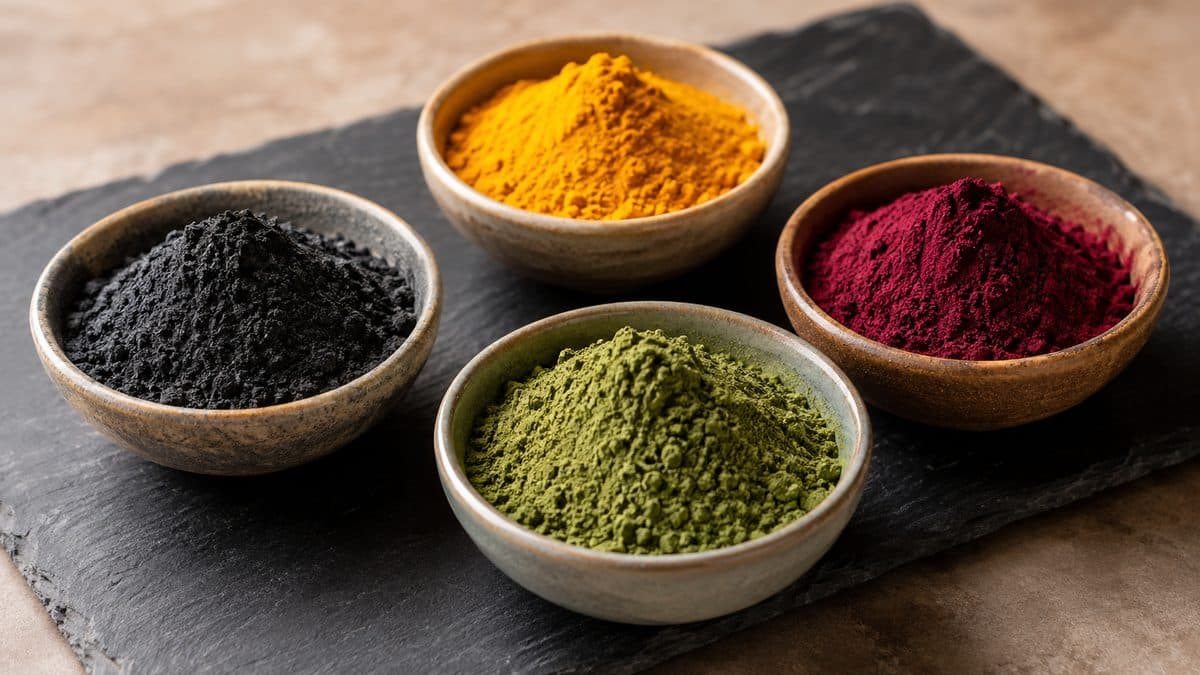
OEM Superfood Powder Manufacturer Malaysia | Spirulina, Moringa & Greens, Halal
Halal OEM superfood powder manufacturing in Perak, Malaysia — spirulina, chlorella, moringa, beetroot, wheatgrass, black sesame and mixed greens blends, produced under your own brand.
Product Range
- Black Sesame Powder
- Turmeric Powder
- Black Bean Powder
- Beetroot Powder
- Moringa Powder
- Mixed Seed Blend
- Five-Colour Superfood Blend
- Spirulina Powder
- Chlorella Powder
- Kurma (Date) Powder
- Wheatgrass Powder
What is superfood powder and who buys it?
Superfood powder is a concentrated plant powder or blend sold on nutrient density — spirulina, chlorella, moringa, wheatgrass, beetroot, acai and mixed greens. It is bought by premium wellness brands and used as a functional addition inside other formulations.
Superfoods are bought with the eyes as much as the mouth. Deep green or vivid beetroot colour is a large part of the perceived value, which makes colour stability a commercial issue rather than a cosmetic one.
The other reality of this category is taste. Most superfoods taste grassy, marine or earthy, so blends usually include a fruit or citrus component whose only job is to make the product drinkable.
What pack formats does superfood powder come in?
Single-serve sachets and stick packs for retail and sampling, jars and tubs for multi-serve, and bulk for brands doing their own downstream packing.
| Format | Typical use |
|---|---|
| Sachet / stick pack | Single serve, retail multi-packs, sampling |
| Jar or tub | Multi-serve home use, gifting, subscription refills |
| Bulk (kg bags / drums) | Brands doing their own downstream filling, food service |
Fill weight, sachet material and shelf-life target are decided together, because they affect each other, and the minimum order quantity depends on which combination you choose.
What matters when formulating superfood powder?
Superfood blends are a compromise between potency and drinkability. Raising the active percentage strengthens the claim and weakens the taste, and finding that line is most of the development work.
- Raw material grade — spirulina and chlorella vary widely by source, and heavy-metal testing is a genuine consideration.
- Active percentage — how much of the pack is actually the superfood versus filler and flavour.
- Taste masking — fruit powders, citrus acidity and mild sweetness are the usual tools.
- Colour stability — greens fade with light and heat; packaging choice directly affects perceived freshness.
- Particle size — too coarse and it feels gritty and settles; too fine and it can clump on the surface.
- Blend uniformity — with several low-inclusion actives, consistent distribution across sachets is a real production concern.
What kinds of superfood powder can you produce?
The range splits into a few distinct directions. Which one you pick drives the formulation, the price point and the buyer more than the individual flavour does.
| Direction | What sits in it | Who it suits |
|---|---|---|
| Green superfoods | Spirulina, chlorella, moringa, wheatgrass, barley grass | Detox and daily-greens positioning |
| Colour and antioxidant | Beetroot, acai, berry, purple sweet potato | Antioxidant and beauty positioning; strong visual appeal |
| Seed and grain superfoods | Black sesame, chia, flax, dates | Traditional and regional nutrition angles |
How is superfood powder manufactured?
Production runs in five stages: raw material intake and checks, dry blending, granulation or agglomeration where the product needs it, filling into the chosen pack, then finished-goods checks before release.
| Stage | What happens | Why it matters to your product |
|---|---|---|
| Raw material intake | Incoming ingredients are checked and their Halal status and documentation verified | A Halal-certified finished product depends on every input being traced, not just the recipe |
| Dry blending | Base powder, creamer, sugar, flavours and actives are weighed and blended to a uniform mix | Blend uniformity decides whether every sachet tastes the same |
| Filling & sealing | Powder is filled to weight into sachets, jars or bulk packs and sealed | Fill weight accuracy and seal integrity drive both cost and shelf life |
| Finished-goods checks | Weight, moisture, appearance, dissolving behaviour and taste are checked before release | Catches the batch that looks fine but will not dissolve in the customer's cup |
Who is superfood powder usually made for?
Brand owners selling through social commerce and agent networks, health and pharmacy retail, food-service and horeca supply, and exporters who need a Halal-certified origin.
| Channel | What the product usually looks like |
|---|---|
| Premium wellness retail | Jars with a clean, minimal label |
| Social commerce | Daily-greens sachet boxes |
| Agent networks | Detox and beauty programme positioning |
| As an ingredient | Bulk superfood powder blended into other products |
| Export | Halal-certified superfood blends |
What shelf life can superfood powder achieve, and what shortens it?
Shelf life is set by moisture, oxygen, light and heat — in roughly that order for powders. The packaging usually matters as much as the formula, because a good powder in a weak barrier will still harden or go stale.
- Moisture pickup — the main enemy. Sugar and acid both attract water, and a powder that absorbs it will cake into a solid block.
- Light exposure — natural colours and matcha fade in clear packaging long before the product is unsafe.
- Colour fade — the fastest visible sign of age in a green or beetroot powder, and the one consumers notice first.
In practice this means a foil or metallised laminate for sachets, a good induction seal on jars, and a desiccant where the formula is especially hygroscopic. Clear packaging looks attractive and costs shelf life.
Declared shelf life is confirmed by stability testing on the actual formula in the actual pack, not estimated from the recipe.
How do I start an OEM order for superfood powder?
Send a brief: the taste or effect you want, target retail price, pack format and rough monthly volume. A reference sample helps more than anything else. From there the sequence is quotation, bench sample, revision, pilot run, then production.
- 1. Brief — what it should taste like, who buys it, target price, format
- 2. Quotation — indicative costing against that brief
- 3. Sample — bench sample for you to taste and revise
- 4. Pilot — a small run to confirm the formula behaves on the line
- 5. Production — full run, packed to your artwork
The first bench sample is free, made to your brief rather than pulled from a shelf. Timelines depend on ingredient lead times and the complexity of the formula, and are confirmed with your quotation.
Where is this manufactured, and under what certification?
At D&O Nutraceutical Manufacturing Sdn. Bhd. in Lahat, Perak, Malaysia — six factory units certified Halal by JAKIM (MS 1500), GMP to MS 1514:2022 (SIRIM QAS, cert. GMP 00203), HACCP to MS 1480:2019 (SIRIM QAS, cert. HACCP 00425), ISO 22000 (SIRIM QAS, cert. FSMS 00229) and MeSTI (Ministry of Health, cert. ME0523069-0/1).
The plant is outside Ipoh, between Kuala Lumpur and Penang, with road access to both Port Klang and Penang Port for export. Four units are used for production and two for packing and assembly, 4,000 sq ft each.
D&O is the powder functional food manufacturer of ORIZI Group. Liquid and ready-to-drink formats are made by Nutrizens Wellness Sdn. Bhd.; cosmetics, skincare and personal care by Dr Orizi; medical devices by Skyler and Imedify.
Certificates and their certified scope are supplied on request. JAKIM Halal certification is verifiable in the MYeHALAL directory, MeSTI in the Ministry of Health FoSIM system, and the GMP, HACCP and ISO 22000 certificates with SIRIM QAS International. The MS standards themselves are published by Standards Malaysia, and ISO 22000 by ISO.
Frequently asked questions
- Can you test for heavy metals?
- Heavy-metal testing is a standard consideration for algae and some plant powders. Testing scope depends on the raw material and the destination market.
- How do you make greens drinkable?
- Usually a fruit or citrus component plus mild sweetness. The trade-off is that every gram spent on masking is a gram not spent on the active.
- Can superfoods be added to other products?
- Yes — superfood inclusions in fruit drinks, protein and meal replacement are common, and are often a better commercial fit than a standalone greens powder.
- Why does my greens powder look paler over time?
- Chlorophyll degrades with light and heat. Opaque packaging and cool storage slow it considerably.
Get a Free Sample of Your Own Product
Tell us what you want to make — the taste or effect, your target retail price, the pack format and rough monthly volume. We come back with a costing and a free bench sample made to your brief, not a stock product. Halal OEM manufacturing in Perak, Malaysia, in sachet, stick pack, jar or bulk.
JAKIM Halal · GMP MS 1514 · HACCP MS 1480 · ISO 22000 · MeSTI certified