
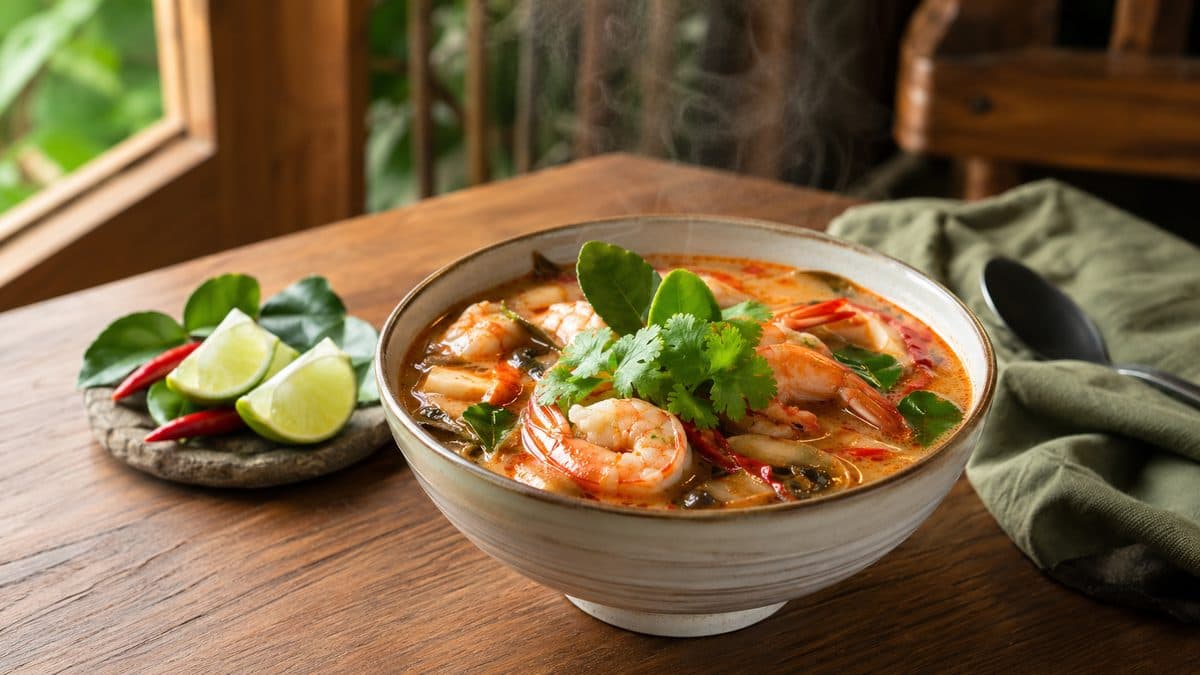
OEM Instant Soup Powder Manufacturer Malaysia | Tom Yam & Herbal Soup, Halal
Halal OEM manufacturing of instant soup powders in Perak, Malaysia — tom yam, herbal chicken, seafood, vegetable and cream soup bases, packed under your own brand in sachet, cup or bulk.
Product Range
- Tom Yam Soup
- Cream of Mushroom Soup
- Cream of Corn Soup
- Chicken Soup
- ABC Soup
- Herbal Chicken Soup
- Seaweed Soup
What is instant soup powder and who buys it?
Instant soup powder is a dried soup base that reconstitutes with hot water. It is bought by brands selling convenience meals, by food service operators who need consistency without a chef, and by institutions feeding people at scale.
Malaysia has a proven appetite for this format. TikTok Shop data from August 2026 shows an instant Thai sour soup powder at RM6.80 with cumulative GMV of RM2.4 million, holding a top-two position in Food & Beverages across multiple days.
The lesson is that the winning products are recognisable regional soups sold cheaply, not novel flavours sold at a premium. Tom yam, asam pedas and herbal chicken have demand already waiting for them.
What pack formats does instant soup powder come in?
Single-serve sachets and stick packs for retail and sampling, jars and tubs for multi-serve, and bulk for brands doing their own downstream packing.
| Format | Typical use |
|---|---|
| Sachet / stick pack | Single serve, retail multi-packs, sampling |
| Cup or bowl | Instant just-add-water eating occasions |
| Bulk (kg bags / drums) | Brands doing their own downstream filling, food service |
Fill weight, sachet material and shelf-life target are decided together, because they affect each other, and the minimum order quantity depends on which combination you choose.
What matters when formulating instant soup powder?
Instant soup is judged on depth. A soup that tastes salty but thin has failed, and building savoury depth without simply adding more salt is the central formulation problem.
- Savoury base — meat, seafood or vegetable stock powder, yeast extract, or a combination. This carries the body of the soup.
- Salt level — easy to over-rely on. Reduced-sodium versions need the depth rebuilt from other sources.
- Acidity — essential for tom yam and asam pedas; tamarind, lime and other souring agents each behave differently when dried.
- Aromatics — lemongrass, galangal, kaffir lime. These are volatile and are the first thing lost in processing and storage.
- Thickening — starch level decides whether the soup is a broth or a cream style.
- Dissolving without lumps — a thickened soup lumps easily in hot water unless the powder is properly granulated.
What kinds of instant soup powder can you produce?
The range splits into a few distinct directions. Which one you pick drives the formulation, the price point and the buyer more than the individual flavour does.
| Direction | What sits in it | Who it suits |
|---|---|---|
| Regional Asian soups | Tom yam, asam pedas, laksa, herbal chicken | Proven demand and strong export appeal |
| Western style | Cream of mushroom, chicken, corn, tomato | Family, institutional and food-service supply |
| Functional and light | Vegetable, low-sodium, collagen and fibre soups | Wellness and weight-management crossover |
How is instant soup powder manufactured?
Production runs in five stages: raw material intake and checks, dry blending, granulation or agglomeration where the product needs it, filling into the chosen pack, then finished-goods checks before release.
| Stage | What happens | Why it matters to your product |
|---|---|---|
| Raw material intake | Incoming ingredients are checked and their Halal status and documentation verified | A Halal-certified finished product depends on every input being traced, not just the recipe |
| Dry blending | Base powder, creamer, sugar, flavours and actives are weighed and blended to a uniform mix | Blend uniformity decides whether every sachet tastes the same |
| Granulation / agglomeration | Fine particles are bound into larger porous granules | This is what makes a powder sink and dissolve instead of floating and clumping |
| Filling & sealing | Powder is filled to weight into sachets, jars or bulk packs and sealed | Fill weight accuracy and seal integrity drive both cost and shelf life |
| Finished-goods checks | Weight, moisture, appearance, dissolving behaviour and taste are checked before release | Catches the batch that looks fine but will not dissolve in the customer's cup |
Who is instant soup powder usually made for?
Brand owners selling through social commerce and agent networks, health and pharmacy retail, food-service and horeca supply, and exporters who need a Halal-certified origin.
| Channel | What the product usually looks like |
|---|---|
| Social commerce | Single sachets at RM4–RM7 and multi-packs |
| Grocery retail | Family cartons |
| Food service and catering | Bulk bases for consistent preparation |
| Institutional supply | Schools, hospitals, dormitories |
| Export | Halal-certified Asian soup bases |
What shelf life can instant soup powder achieve, and what shortens it?
Shelf life is set by moisture, oxygen, light and heat — in roughly that order for powders. The packaging usually matters as much as the formula, because a good powder in a weak barrier will still harden or go stale.
- Moisture pickup — the main enemy. Sugar and acid both attract water, and a powder that absorbs it will cake into a solid block.
- Aroma loss — volatile spice oils are the whole point of a seasoning, and they are the first thing to fade.
- Fat oxidation — creamer and nut oils go stale before anything else fails, giving a cardboard or rancid note.
In practice this means a foil or metallised laminate for sachets, a good induction seal on jars, and a desiccant where the formula is especially hygroscopic. Clear packaging looks attractive and costs shelf life.
Declared shelf life is confirmed by stability testing on the actual formula in the actual pack, not estimated from the recipe.
How do I start an OEM order for instant soup powder?
Send a brief: the taste or effect you want, target retail price, pack format and rough monthly volume. A reference sample helps more than anything else. From there the sequence is quotation, bench sample, revision, pilot run, then production.
- 1. Brief — what it should taste like, who buys it, target price, format
- 2. Quotation — indicative costing against that brief
- 3. Sample — bench sample for you to taste and revise
- 4. Pilot — a small run to confirm the formula behaves on the line
- 5. Production — full run, packed to your artwork
The first bench sample is free, made to your brief rather than pulled from a shelf. Timelines depend on ingredient lead times and the complexity of the formula, and are confirmed with your quotation.
Where is this manufactured, and under what certification?
At D&O Nutraceutical Manufacturing Sdn. Bhd. in Lahat, Perak, Malaysia — six factory units certified Halal by JAKIM (MS 1500), GMP to MS 1514:2022 (SIRIM QAS, cert. GMP 00203), HACCP to MS 1480:2019 (SIRIM QAS, cert. HACCP 00425), ISO 22000 (SIRIM QAS, cert. FSMS 00229) and MeSTI (Ministry of Health, cert. ME0523069-0/1).
The plant is outside Ipoh, between Kuala Lumpur and Penang, with road access to both Port Klang and Penang Port for export. Four units are used for production and two for packing and assembly, 4,000 sq ft each.
D&O is the powder functional food manufacturer of ORIZI Group. Liquid and ready-to-drink formats are made by Nutrizens Wellness Sdn. Bhd.; cosmetics, skincare and personal care by Dr Orizi; medical devices by Skyler and Imedify.
Certificates and their certified scope are supplied on request. JAKIM Halal certification is verifiable in the MYeHALAL directory, MeSTI in the Ministry of Health FoSIM system, and the GMP, HACCP and ISO 22000 certificates with SIRIM QAS International. The MS standards themselves are published by Standards Malaysia, and ISO 22000 by ISO.
Frequently asked questions
- Can you make a tom yam soup powder?
- Yes — it is the highest-demand flavour in this category in Malaysia. The work is holding the aromatics and the sour-spicy balance through drying.
- Can soups be made MSG-free?
- Yes. Yeast extract, mushroom powder and fermented savoury ingredients are used to build umami depth instead.
- Can you do low-sodium soups?
- Yes, though salt is doing more than seasoning — it is carrying perceived depth. Reduced-sodium versions need that depth rebuilt from other sources.
- Cup format or sachet?
- Cups carry a higher price and a complete eating occasion; sachets are cheaper to produce and ship, and perform better in social commerce.
Get a Free Sample of Your Own Product
Tell us what you want to make — the taste or effect, your target retail price, the pack format and rough monthly volume. We come back with a costing and a free bench sample made to your brief, not a stock product. Halal OEM manufacturing in Perak, Malaysia, in sachet, stick pack, jar or bulk.
JAKIM Halal · GMP MS 1514 · HACCP MS 1480 · ISO 22000 · MeSTI certified