
Tea · Malaysian
OEM Teh Tarik Powder Manufacturer in Malaysia
OEM & private label teh tarik powder - 3-in-1 pulled milk tea with foam, Halal manufactured in sachet, stick pack or bulk for your brand.
Why is it called teh tarik?
Tarik means pulled. The drink is named after how it is made: poured repeatedly between two containers with the arms stretched apart, which cools it for drinking and whips a thick froth onto the top. It is considered Malaysia's national drink.
Teh tarik is the fixture of mamak stalls, kopitiam and roadside stands across Malaysia, Brunei, Singapore, Indonesia and southern Thailand. The pull is not showmanship. It aerates the tea and drops the temperature at the same time, and the froth it produces is as much part of the drink as the taste.
Underneath the theatre it is strong black tea with condensed and evaporated milk. The tea has to be brewed hard enough to survive that much milk, which is why teh tarik tastes markedly more tannic than a Western milk tea and why a weak tea base is immediately obvious.
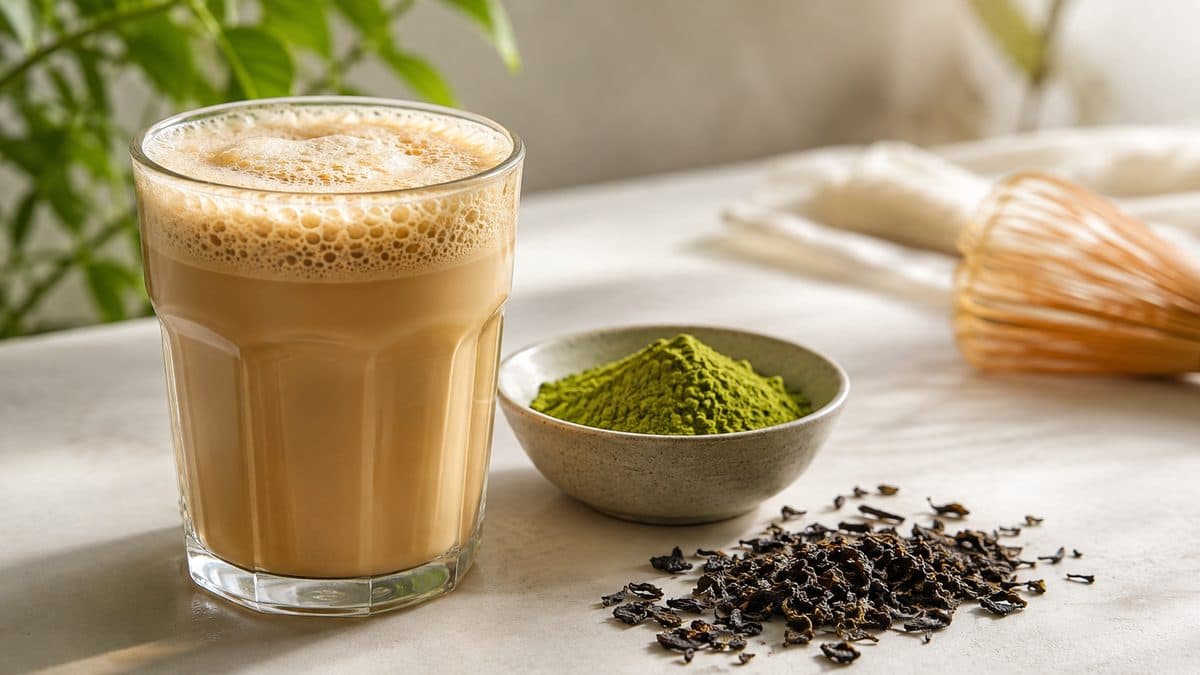
That froth is the whole problem for a powder, and the whole opportunity. A buyer who has drunk teh tarik at a stall expects a head on it. A flat cup reads as a failed copy of the drink rather than an instant version of it.
What does teh tarik taste like?
Strong, sweet and creamy, with a firm tannic backbone that keeps the condensed milk from taking over. Fuller and more astringent than a Western milk tea, and the froth on top changes how it feels as much as how it tastes.
| Character | Level | Why |
|---|---|---|
| Sweetness | High | Condensed milk is part of the recipe, not an addition to it. |
| Bitterness | Medium | Tea has to be brewed hard to survive the milk, so tannin is present by design. |
| Roast | Low | No roasting is involved - this axis is near-absent in a black tea drink. |
| Creaminess | High | Condensed and evaporated milk together; the drink does not exist without them. |
| Aroma | Medium | Malty black tea and cooked-milk notes, rounder than a fragrant tea. |
Indicative flavour positioning to help write a product brief. It is not sensory panel data, and the finished taste is set with you at sampling stage.
What has to be decided to make teh tarik as a powder?
Foam, before anything else. Everything a brand owner expects from teh tarik is in the head on the cup, and an instant powder has to generate it from a stir rather than from being pulled between two mugs.
- The foam has to come from the powder. No consumer is going to pull a sachet drink between two containers. The aeration that the pour normally supplies has to be built into the blend instead, and whether it survives stirring is the single sharpest pass-fail test for this product.
- The tea base has to be strong enough to be heard through the milk. Teh tarik uses a hard brew for a reason. A standard instant tea extract disappears behind condensed milk and the result tastes like sweet milk, not tea.
- Tannin and milk protein interact. Strong tea plus milk protein can produce haze, sediment or a chalky mouthfeel once reconstituted - invisible when freshly brewed, obvious in an instant product.
- Dissolving temperature is part of the spec. Teh tarik is drunk hot and fast. A powder that needs near-boiling water and a long stir does not match how the drink is actually consumed.
What are the Halal risk points in a teh tarik powder?
The milk system and the foaming agent. Creamers and milk powders bring their own documentation, and the emulsifiers used to build and hold foam - commonly mono- and diglycerides (E471) - can be plant or animal derived under the same name.
Foaming is where this product differs from a plain milk tea: the emulsifier load is higher because it has a job to do, which makes E471 sourcing more consequential here than in a drink where it is only a processing aid. A plant-derived grade exists for practically every application but must be specified and certificated, not assumed.
D&O manufactures under JAKIM Halal certification to MS 1500, and every raw material entering a Halal-certified line carries its own valid certificate. The common failure points are listed in Top 10 Ingredients That Fail Halal Certification.
Which pack formats suit teh tarik powder?
Sachet, stick pack, jar or bulk. The format is chosen with the formula rather than after it, because it decides how the powder is protected from moisture and how the buyer meets the product.
| Format | What it suits |
|---|---|
| Sachet | The standard 3-in-1 single serve. Fixed dose matters here because the foam depends on the powder-to-water ratio. |
| Stick pack | Office, travel and export bundles, with the same dose control as a sachet. |
| Jar | Repeat home use, though a free-poured scoop makes the foam less consistent than a fixed sachet. |
| Bulk | Food service and mamak supply, and brands filling their own packs. |
Where is this manufactured, and under what certification?
At D&O Nutraceutical Manufacturing Sdn. Bhd. in Lahat, Perak, Malaysia — six factory units certified Halal by JAKIM (MS 1500), GMP to MS 1514:2022 (SIRIM QAS, cert. GMP 00203), HACCP to MS 1480:2019 (SIRIM QAS, cert. HACCP 00425), ISO 22000 (SIRIM QAS, cert. FSMS 00229) and MeSTI (Ministry of Health, cert. ME0523069-0/1).
The plant is outside Ipoh, between Kuala Lumpur and Penang, with road access to both Port Klang and Penang Port for export. Four units are used for production and two for packing and assembly, 4,000 sq ft each.
D&O is the powder functional food manufacturer of ORIZI Group. Liquid and ready-to-drink formats are made by Nutrizens Wellness Sdn. Bhd.; cosmetics, skincare and personal care by Dr Orizi; medical devices by Skyler and Imedify.
Certificates and their certified scope are supplied on request. JAKIM Halal certification is verifiable in the MYeHALAL directory, MeSTI in the Ministry of Health FoSIM system, and the GMP, HACCP and ISO 22000 certificates with SIRIM QAS International. The MS standards themselves are published by Standards Malaysia, and ISO 22000 by ISO.
Where this flavour is produced
Teh tarik sits in the Tea Powder line. The full list of instant beverage & dessertflavours D&O has produced is in the flavour library.
Frequently asked questions
- Why is teh tarik pulled?
- For two practical reasons. Pouring the tea repeatedly between containers cools it to drinking temperature, and the aeration builds the thick froth on top. The display is a side effect of a technique that does a job, not the reason for it.
- Can instant teh tarik powder actually produce foam?
- Yes, but only if the blend is built for it. The aeration a pour supplies has to come from the formulation instead, and it has to survive an ordinary stir rather than vigorous pouring. Whether the head holds is the clearest test of whether the product works.
- Why does teh tarik taste stronger than other milk teas?
- Because the tea is brewed hard to stand up to condensed and evaporated milk. That leaves more tannin in the cup, which is what gives teh tarik its astringent backbone. Use a lighter brew and the milk simply takes over.
- What makes an instant teh tarik taste thin?
- Almost always a weak tea base. Condensed milk is sweet and heavy, and an ordinary instant tea extract is swallowed by it. The fix is in the extract strength, not in adding more flavouring on top.
- How does the sampling stage work?
- A brief goes to the R&D lab, which produces a bench sample for you to taste and adjust. Revisions are normal and expected, because taste targets are easier to describe by comparison than in words. Only once the sample is signed off does the formula, the pack format and the documentation get fixed.
- Which pack format should I choose?
- Sachets and stick packs suit single servings, trial sizes and e-commerce, because the dose is fixed and the barrier protects the powder. Jars suit repeat home use. Bulk suits a brand doing its own filling. Hygroscopic flavours, which draw moisture from the air, are better in a sealed sachet than in a jar that is opened daily.
- Is the factory Halal certified?
- Yes. D&O manufactures at a JAKIM-certified plant in Lahat, Perak, certified for food against MS 1500, the Malaysian Halal standard. Certificates can be checked through JAKIM's MYeHALAL directory, and MS 1500 is published by the Department of Standards Malaysia.
- Can two flavours be combined in one product?
- Yes, and most launches do. Pairings such as mango with passionfruit, or black sesame with oat, are common in powder formats. The blend is worked out at sampling stage against your target retail price, because the ratio moves the cost as well as the taste.
Get a Free Sample of Your Own Product
Tell us what you want to make — the taste or effect, your target retail price, the pack format and rough monthly volume. We come back with a costing and a free bench sample made to your brief, not a stock product. Halal OEM manufacturing in Perak, Malaysia, in sachet, stick pack, jar or bulk.
JAKIM Halal · GMP MS 1514 · HACCP MS 1480 · ISO 22000 · MeSTI certified