


Every company below was opened in a browser in August 2026, its own website read, and a page screenshotted. Nothing here is written from memory.
Doing it that way overturned something this site had published a week earlier. We had written that a Japanese factory generally cannot give you Halal certification. One of the ten states plainly that it can, with a dedicated Halal production line — so that guidance has been corrected. The detail is at entry 1.
Who is this list for?
A brand owner in Malaysia, Singapore or Indonesia who wants a Japanese-made supplement — usually for the origin claim as much as the formulation — and needs to know which factories exist, which of them own their production line, and which will quote a first order.
The regulatory groundwork is in OEM Supplement Manufacturer in Japan. Settle the Halal question and your Malaysian registration route before you contact anyone.
Does any Japanese OEM offer Halal certification?
Yes — and this is the correction. UMEKEN states it is certified to produce Halal products by the Nippon Asia Halal Association, and separately holds BPJPH (Indonesia) certification, running a dedicated Halal production line. It is the exception rather than the rule: seven of the ten below make no Halal claim at all.
Before you plan around any of it, check whether the certifying body appears on JAKIM's list of recognised foreign Halal certification bodies. A certificate that JAKIM does not recognise will not put a logo on a Malaysian pack. The BPJPH certification is the more interesting one for anyone selling into Indonesia.
1. UMEKEN
States over 45 years in health food OEM contract manufacturing. Its site runs in Japanese, English, Korean and Indonesian.
Certifications stated: GMP for dietary supplements (since 2005), cGMP compliance to the US standard, Organic JAS, Halal certification by the Nippon Asia Halal Association, and Halal certification by BPJPH (Indonesia), with a separate production line for Halal products.
Formats stated: ball-form (ganzai), tablets, coated and sugar-coated, granules and powder, paste, soft capsules, hard capsules.
Manufacturing note. Ball-form ganzai is the unusual capability here — it blends high-viscosity concentrated extract without powdering the ingredient first, and the company notes few OEM manufacturers can do it. Combined with the Halal line and an Indonesian-language site, this is the one Japanese manufacturer on the list visibly built for Muslim-market export.
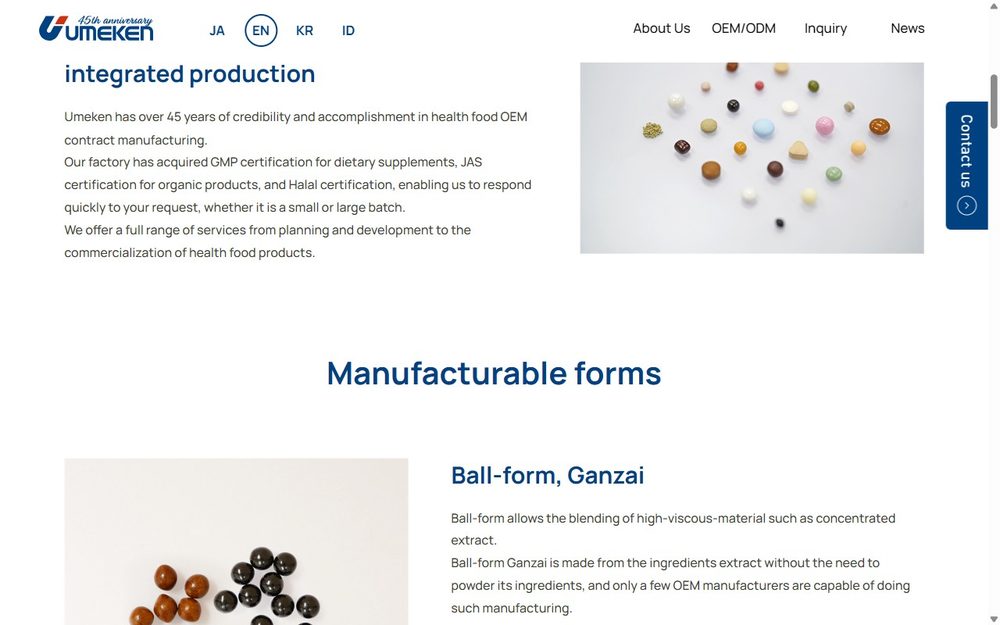
umeken.co.jp, OEM/ODM supplement page, captured August 2026.
2. Sumioka Foods Corporation
Health foods and supplements alongside dried and instant noodles, from four factories in Shizuoka — the Sumioka headquarters and Hamakita plants in Hamamatsu, and two ES Foods plants in Kosai and Hamamatsu. States more than 100 years of tradition.
Certifications stated: Health Food GMP from the Japan Health and Nutrition Food Association (JHNFA) at the Hamakita and ES Foods Hamamatsu plants.
Supports small-lot production.
Manufacturing note. A company that makes both instant noodles and supplements has powder blending, drying and sachet filling under one roof. For a Malaysian brand thinking about instant powder formats rather than capsules, that combination is more relevant than a pure capsule house.
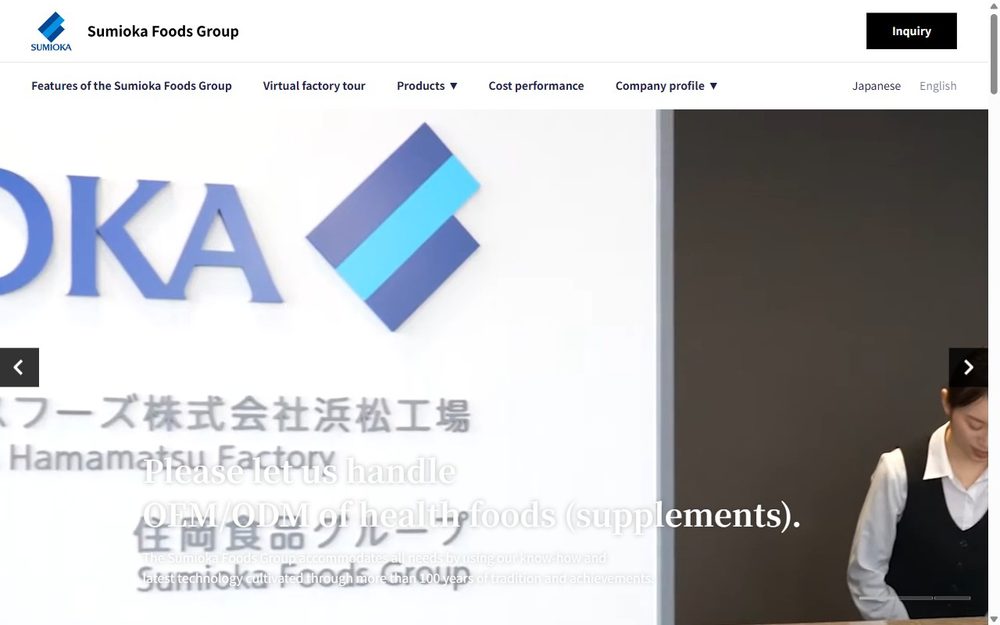
sumioka.co.jp, captured August 2026.
3. Morishita Jintan
Head office in Tamatsukuri, Osaka. Manufactures pharmaceuticals, functional foods and dietary supplements, and offers OEM contract manufacturing.
Formats stated: seamless capsules from 0.5 to 8.0 mm diameter, granules, tablets, hard capsules, and sequential stick-type packaging combining capsules and granules. GMP is stated as the production standard.
Manufacturing note. Seamless capsule technology is this company's signature and it is genuinely difficult to source elsewhere. A 0.5 mm seamless capsule suspended in a granule stick is a format most factories simply cannot quote — if your product idea depends on it, the shortlist is short.
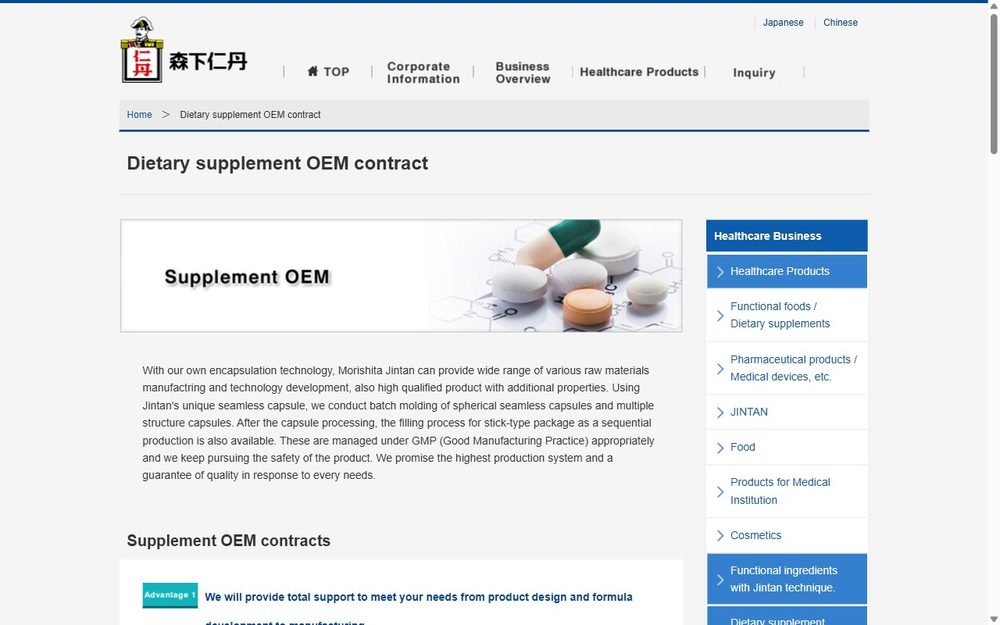
jintan.co.jp, captured August 2026.
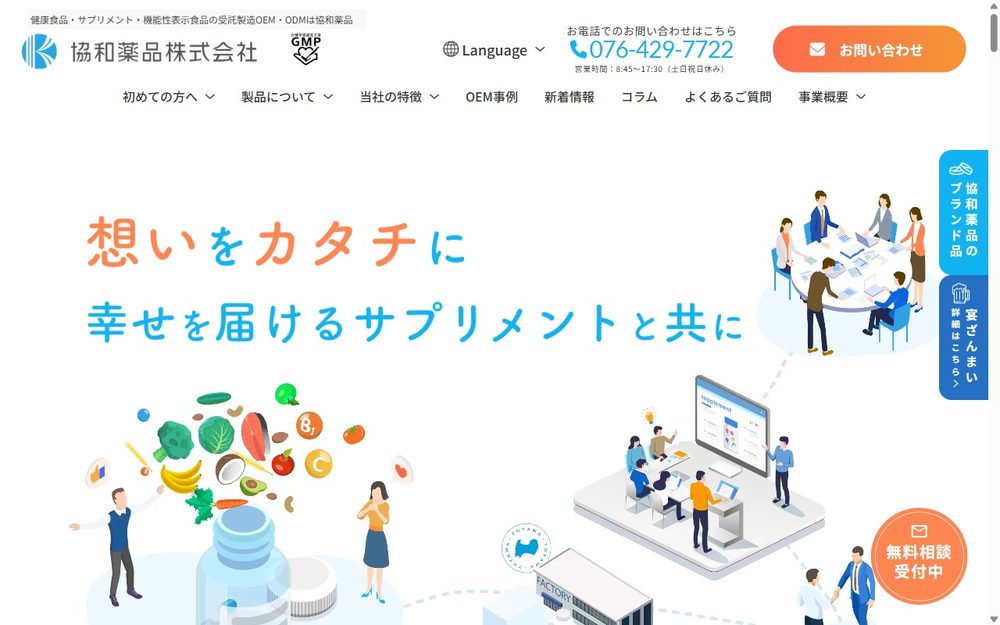
4. Kyowa Yakuhin
Toyama City, Toyama Prefecture. States over 50 years in operation, with its own GMP-certified facility plus partner factories.
Formats stated: powders, granules, tablets, hard and soft capsules, drinks in 30/50/100 ml and 180–900 ml bottles, stick-form gels, pouches, aluminium pouches and divided packages.
Minimum lot, as published by the company: approximately 300 units using existing bulk inventory, and approximately 1,400 units for an original formulation (50 kg minimum).
Certifications stated: GMP certification from the Japan Health and Nutrition Food Association. Holds Halal certification for one of its own raw materials (soursop) — note this is an ingredient certification, not a plant certification.
Manufacturing note. Publishing two different minimum lots — one for an existing bulk, one for an original formula — is the most honest thing on any of these websites. It is exactly the trade-off a first-time brand faces: take our recipe and start small, or write your own and commit to volume.
kyowa-yakuhin.co.jp, captured August 2026.
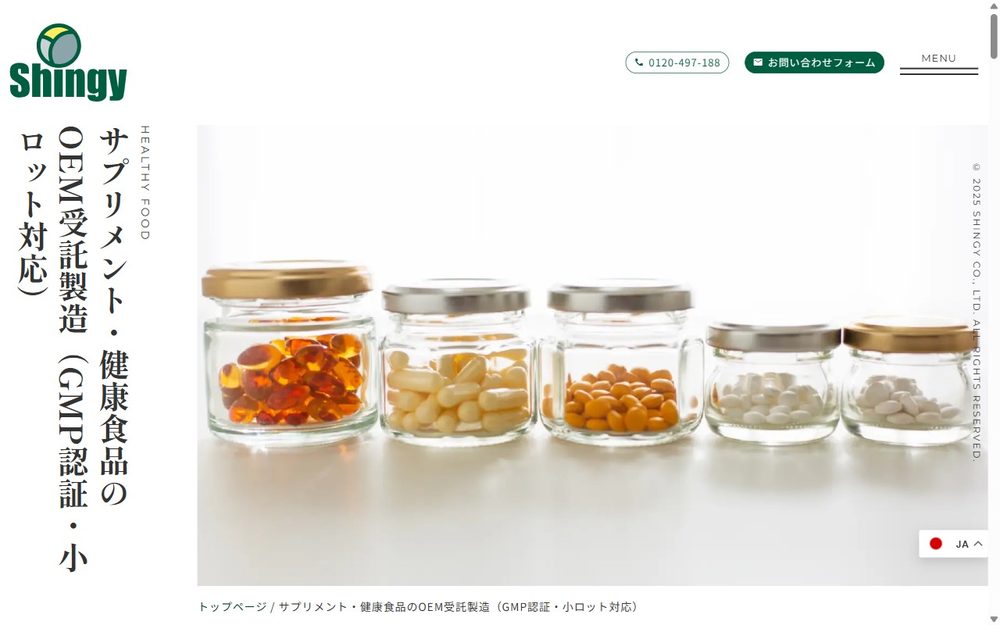
5. Shingy
Two plants: Tomobe in Kasama, Ibaraki Prefecture, and a Tianjin plant in China.
Certifications stated: JHNFA GMP certification (no. 34025) at Tomobe; ISO 22000 at Tianjin.
Formats stated: tablets, hard and soft capsules, granules, tea, gummies, jellies, bars and cookies. States a minimum lot from 500 units, varying by format.
Manufacturing note. The Japan-plus-China plant pairing is the commercially interesting part: it lets a buyer run the premium "Made in Japan" version and a cost version from one supplier relationship. Confirm which plant your quotation refers to — the origin claim on your pack depends entirely on that answer.
shingy.co.jp, captured August 2026.
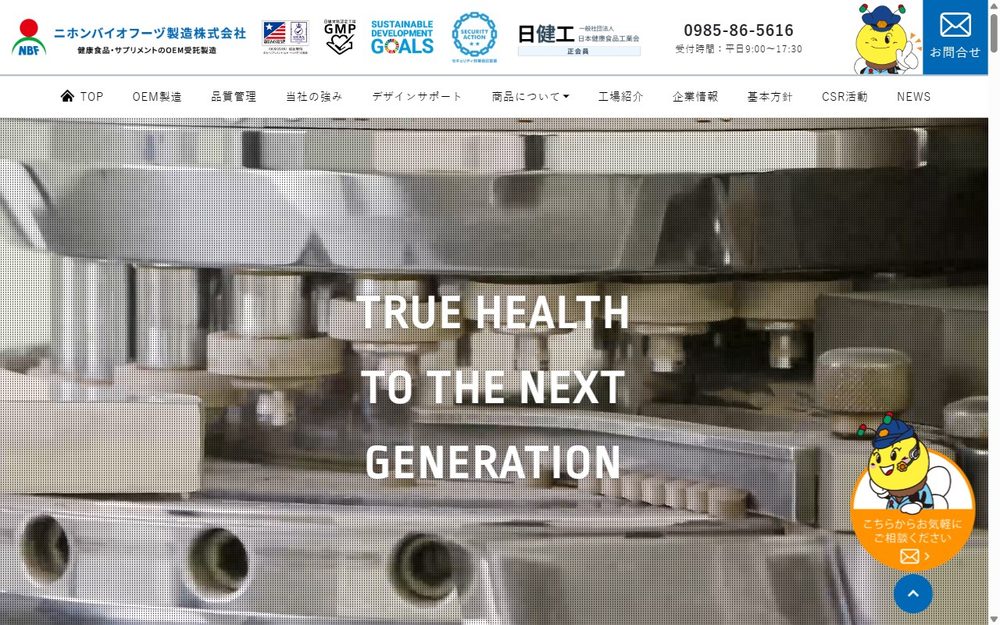
6. Nihon Bio Foods Manufacturing
Miyazaki City, Miyazaki Prefecture, with branch offices in Tokyo (Chuo) and Fukuoka (Hakata).
Certifications stated: ISO 22000:2018 and JHNFA-certified GMP.
Formats stated: soft capsules, hard capsules, tablets, powder and granules. States small-lot manufacturing from approximately 500 units.
Manufacturing note. A stated 500-unit minimum is small enough for a genuine market test rather than a launch commitment. For a brand validating a concept before spending on a full run, this tier of Japanese manufacturer is far more approachable than the household names.
n-biofoods.com, captured August 2026.
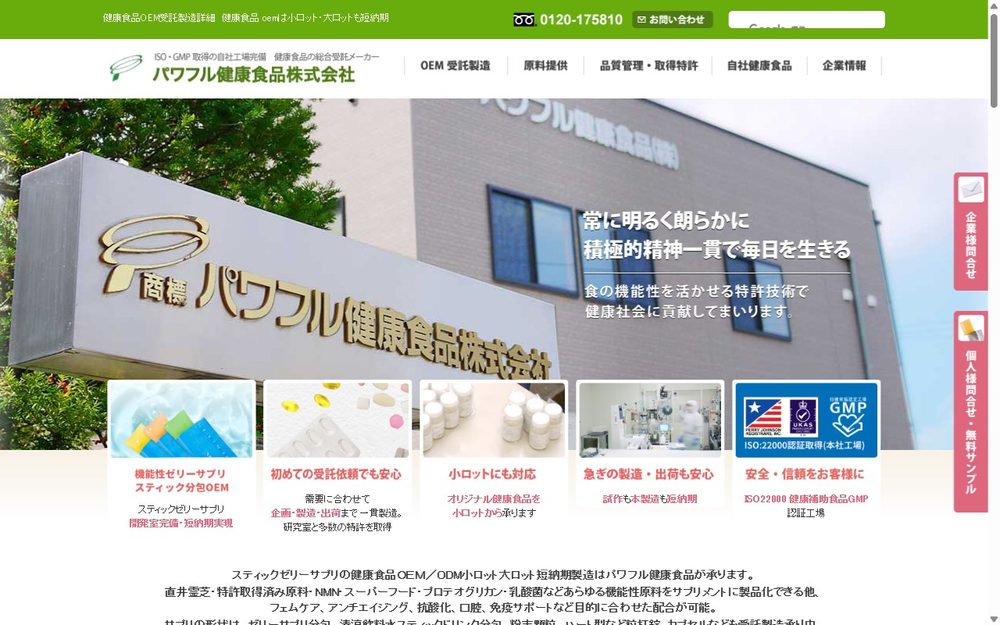
7. Powerful Health Food
Shinano Town, Nagano Prefecture. Owns its own factory. States 1981 as its founding year, marking a 45th anniversary in 2026.
Certifications stated: ISO 22000:2018 and Health Supplement GMP.
Formats stated: stick jelly and gummies (described as its most popular), tablets and granules, paste and thick beverages, powders, soft and hard capsules, sugar-coated granules, bottled drinks, and pet supplements.
Manufacturing note. Stick jelly leading the format list matters for a Southeast Asian buyer, because jelly sticks are the format Korean and Japanese brands sell into ASEAN and Malaysian factories least often quote. The pet line is a second business most brand owners overlook.
pawafuru.co.jp, captured August 2026.
8. Nihon Vitamin Chemical
Toyama City, Toyama Prefecture. Manufactures pharmaceuticals and health foods, and offers OEM. States it produces for Japan and overseas.
Certifications stated, with dates: GMP certification for dietary supplements obtained 28 January 2026, and JFS-B certification for health foods obtained 8 August 2025.
Manufacturing note. Publishing the date each certificate was obtained is unusual and useful — it lets you ask for the current certificate against a known issue date instead of taking a logo on a website at face value. Toyama's pharmaceutical tradition is the region's calling card.
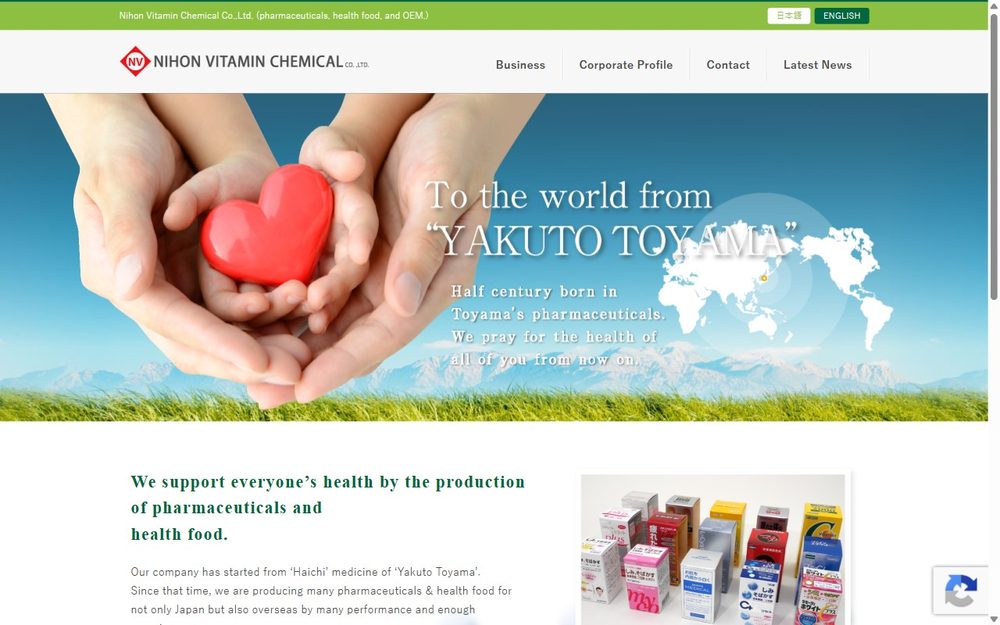
nv-kagaku.jp, captured August 2026.
9. Have fun Factory
Miyazaki City, Miyazaki Prefecture. States it owns a GMP-certified in-house facility, and positions on small lot, short lead time and low cost. Formats cover various capsules, tablets and granules.
Manufacturing note. The positioning is the information. A factory that leads with short lead time is telling you its scheduling is built around many small jobs rather than a few large ones — which is what a brand doing seasonal or trial runs actually needs.
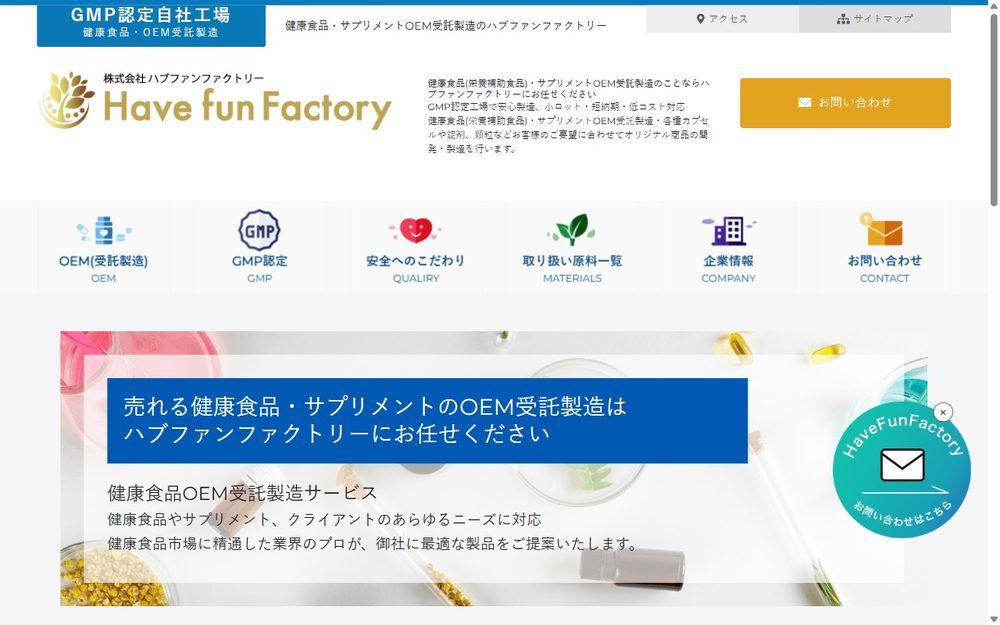
h-f-factory.com, captured August 2026.
10. IWASE COSFA — a network, not a factory
Included deliberately, and labelled honestly: IWASE COSFA does not own the plants. It works through "a nationwide network of partner factories" from Kanto to Kyushu. One named partner facility in Kitakyushu, Fukuoka, is stated as GMP-certified for health foods.
Capabilities stated: technologies to improve the taste of bitter ingredients, emulsification, and production of jellies, drinks, pastes and granules.
Minimum lots, as published: 30,000 units for three-side stick jellies, 15,000 for T-pouches, 10,000 for Easy Snap formats.
Manufacturing note. Bitterness masking is a real technical service and worth paying for — many functional ingredients fail on taste rather than on function. But know what you are buying: a coordinator, with a factory behind it. Ask which plant will make your product, what it is certified for, and whether you can visit. The same question applies to Panel Japan, a Tokyo supplier that likewise partners with GMP-, ISO- and Halal-certified factories rather than owning them.
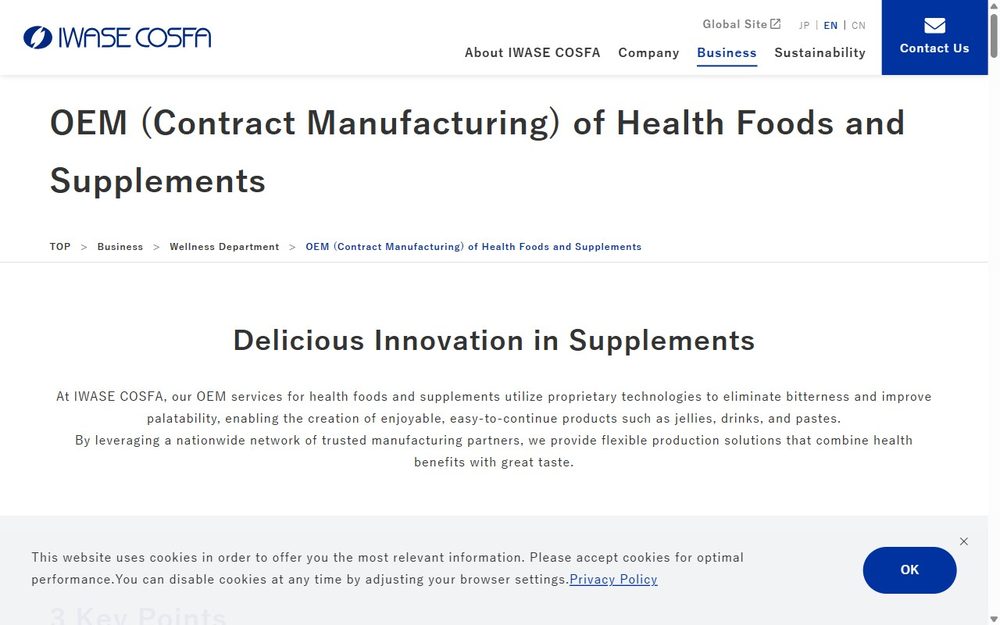
cosfa.co.jp, captured August 2026.
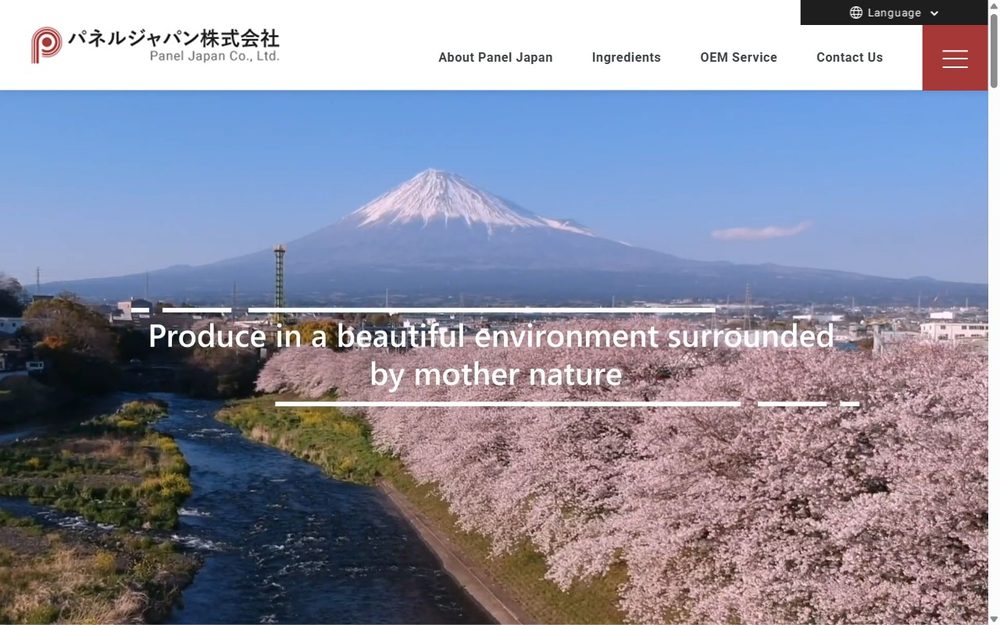
panel-japan.co.jp, captured August 2026.
What does this list tell you?
| Finding | What it means for your enquiry |
|---|---|
| Japanese OEMs publish minimum lots | Kyowa Yakuhin, Shingy, Nihon Bio Foods and IWASE COSFA all state theirs. Korea's do not. Ask, and expect an answer |
| Small-lot capability is common | Several state 300–500 units. Japan is more approachable for a first run than its reputation suggests |
| Halal exists, but is the exception | One plant-level Halal certification in ten. Verify the certifying body against JAKIM's list |
| Some "manufacturers" are networks | IWASE COSFA and Panel Japan coordinate partner factories. Legitimate — but ask which plant, and what it is certified for |
| Formats Malaysia rarely quotes | Seamless capsules, ball-form ganzai, stick jelly, gummies. If your concept needs one, Japan is a genuine reason to look |
How should you shortlist?
- Decide the Halal question first. In Japan it narrows the field to roughly one, so it decides the country.
- Ask who owns the plant. Half a dozen answers on this page differ.
- Ask which lot size applies to your format, not to their easiest one.
- Contract for English documentation in advance. Several of these sites are Japanese only.
- Ask for the certificate, not the certification claim.
The full question list is in Top 10 Questions to Ask an OEM Supplement Manufacturer in Malaysia.
Where D&O fits
D&O Nutraceutical Manufacturing manufactures powder functional food — instant beverages, supplement powders, meal replacement, savoury instant food and seasoning — at its plant in Lahat, Perak. Certifications: Halal (JAKIM, MS 1500), GMP (SIRIM QAS, MS 1514:2022, cert. GMP 00203), HACCP (SIRIM QAS, MS 1480:2019, cert. HACCP 00425), ISO 22000 (cert. FSMS 00229) and MeSTI (cert. ME0523069-0/1).
We are not on this list and should not be — it is a list of Japanese factories. Where we are usually the better answer is a Halal-certified powder product selling across ASEAN and the Gulf from one production run. Where Japan is the better answer is an origin-led product, or a format like seamless capsules that we do not make.
Frequently asked questions
Can a Japanese OEM manufacturer produce Halal supplements? One of the ten verified here states it can: UMEKEN, certified by the Nippon Asia Halal Association and by BPJPH in Indonesia, with a dedicated Halal production line. Check whether the certifying body appears on JAKIM's list of recognised foreign Halal certification bodies before planning a Malaysian pack around it.
What is the minimum order for a Japanese supplement OEM? It varies by factory and format, and several publish theirs: Kyowa Yakuhin states about 300 units on an existing bulk and about 1,400 for an original formulation; Shingy and Nihon Bio Foods state from 500 units; IWASE COSFA states 10,000 to 30,000 depending on the pack format. Ask for the figure attached to your format.
Do Japanese OEM manufacturers own their factories? Most on this list do. IWASE COSFA and Panel Japan work through partner factories instead — a legitimate model, but ask which plant will make your product and what it is certified for.
What can Japan make that Malaysia usually cannot? Seamless capsules down to 0.5 mm, ball-form ganzai, stick jelly and gummies are the formats that come up repeatedly on these sites and are hard to source in Malaysia.
How current is this? Every entry was captured in August 2026. Certifications and websites change — treat anything older than a few months as a lead to re-check, not a fact.
What we did and did not do
Every entry above is what the company states about itself on its own website, read in August 2026. We have not visited or audited any of these plants, and the order is by profile and scale rather than by merit. It is where your own due diligence starts, not where it finishes.