
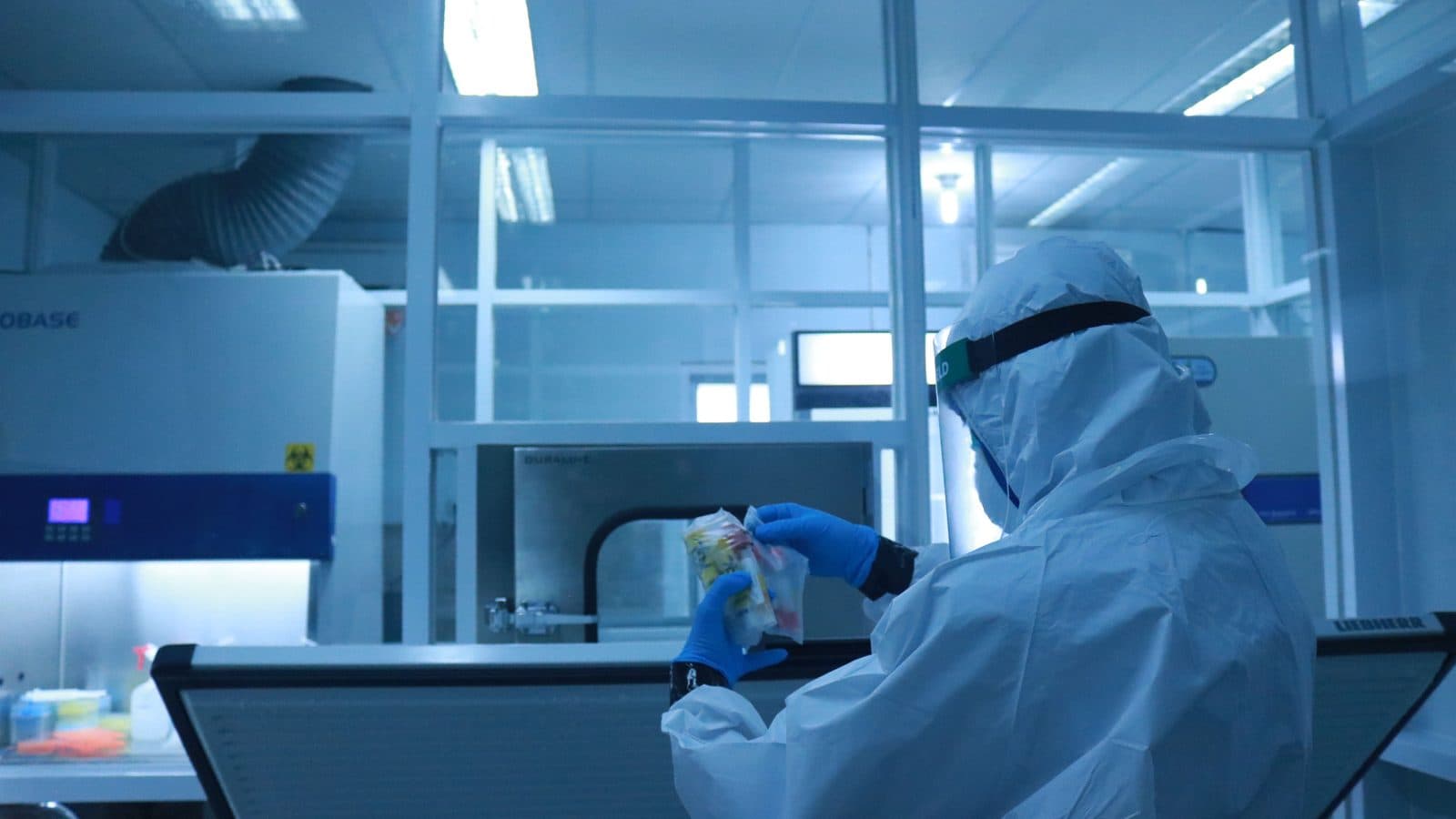


Most "Top 10 Korean supplement manufacturer" lists are assembled from other lists. This one was not. Every company below was opened in a browser in August 2026, its own website read, and its homepage screenshotted. What each entry says is what the company says about itself.
Three candidates were dropped rather than padded. Two of them are traps that catch anyone writing this kind of list from memory, and they are worth reading before the list itself.
Who is this list for?
A brand owner in Malaysia, Singapore or Indonesia who wants a Korean-made supplement — usually a stick pack, jelly stick or inner-beauty powder — and needs to know which factories exist, what they specialise in, and which of them realistically takes a first order from a foreign brand.
Two things to settle before you contact anyone, both covered in OEM Supplement Manufacturer in Korea: whether your market needs a Halal logo, and which Malaysian regulatory route your product form falls under. Neither is fixable later.
Which Korean companies are the "Big 4"?
Korean trade press consistently names four companies as the country's health functional food ODM leaders: Novarex, Kolmar BNH, Cosmax BTI and Suheung. All four are below. They are built around large domestic brands, and that shapes how they answer a small foreign enquiry.
1. Kolmar BNH
Describes itself on its own English site as "Korea's Global Health Functional Food ODM Company." Plants at Sejong and Eumseong (Chungcheongbuk-do), plus facilities in China and Australia.
Formats stated: tablets, softgels, hard capsules, powder sticks, liquid sticks, jelly sticks and liquid vials — across VMS, joint and bone, immunity and inner beauty.
Certifications stated: GMP from Australia's TGA (2021), and FSSC 22000 at both Korean sites.
Manufacturing note. The format list is the point. Jelly sticks and liquid vials are the two formats a Southeast Asian factory most often cannot quote, and here they are standard rather than special.
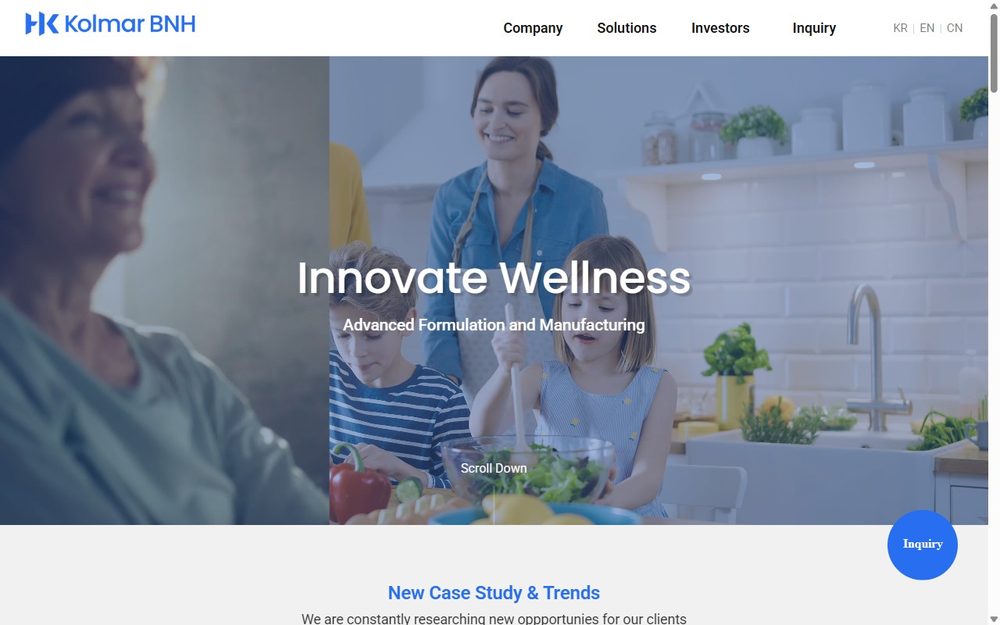
kolmarbnh.co.kr, captured August 2026.
2. Cosmax NBT
Part of the Cosmax group. Head office in Pangyo, Seongnam; production plant in Icheon, Gyeonggi-do. States around 600 partner companies.
Company news on its own site: expanding jelly and liquid capacity, and an active push into Vietnam with a one-stop service from raw material to finished product.
Manufacturing note. A manufacturer publicly investing in jelly and liquid lines is telling you where Korean format demand is heading. If your concept is a powder sachet, ask what it would cost as a jelly stick before you commit — that is the format the Korean supply chain is currently building capacity for.
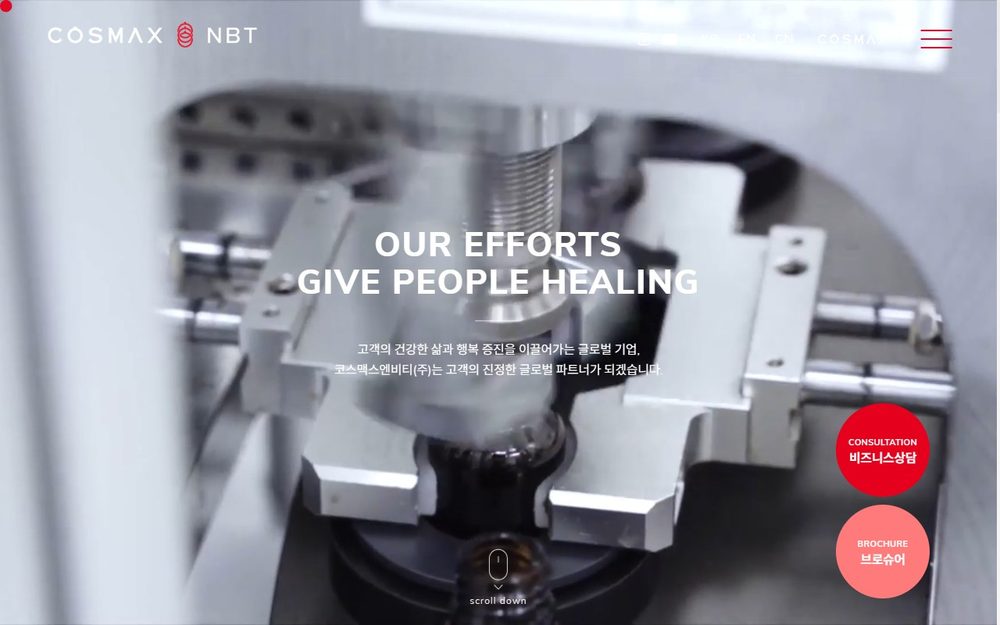
cosmaxnbt.com, captured August 2026.
3. Novarex
The site's own page title reads "대한민국 대표 건강기능식품 ODM OEM 기업" — Korea's representative health functional food ODM/OEM company. Around 30 years in the business. Osong plant in Cheongju, Chungcheongbuk-do, with its own life science research institute; separate Seoul office.
Its stated differentiator: the largest number of individually approved functional ingredients in Korea.
Manufacturing note. That claim matters more than it looks. Korea's HFF system splits functional ingredients into generally recognised and individually approved, and an individual approval belongs to whoever obtained it. A factory holding many of them can offer a formula nobody else can make — and by the same token, you cannot take that formula anywhere else. Ask who owns the approval before you build a brand on it.
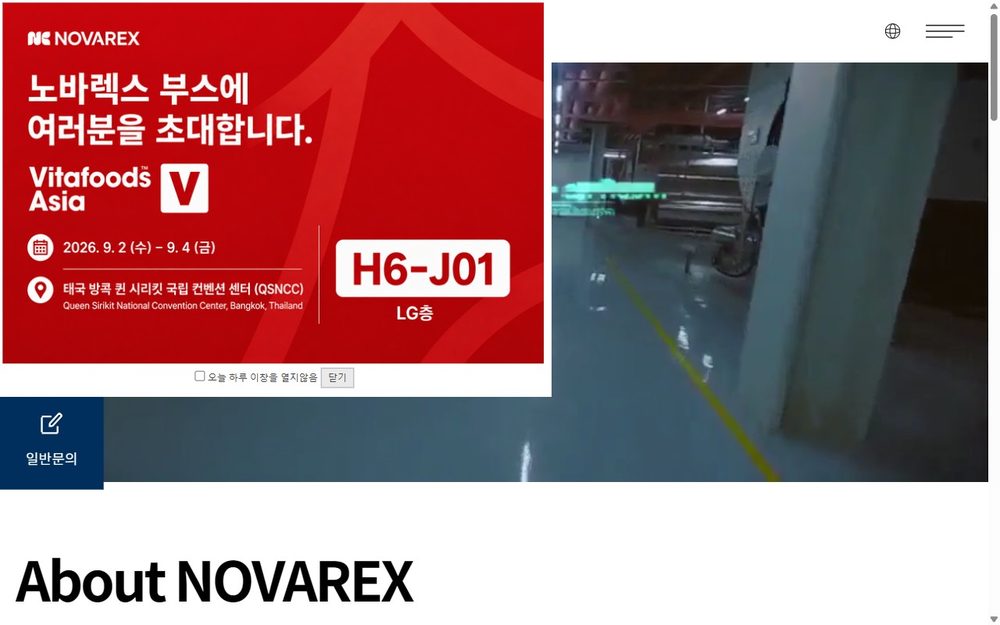
novarex.co.kr, captured August 2026.
4. Cosmax Bio
The nutraceutical arm of the Cosmax group, separate from Cosmax NBT. Head office at Jecheon Bio Valley, Chungcheongbuk-do; Pangyo office.
States a first-in-Korea enteric softgel series and a first-in-Korea plant-based softgel series, MFDS individual recognition for a sleep-function extract (April 2026), and selection as a third-round personalised health functional food special-case operator, with the right to run ten sites.
Manufacturing note. Plant-based softgel capability is worth naming specifically: a standard softgel shell is gelatin, usually bovine or porcine, and that is where a vegetarian or Halal positioning quietly dies. A plant-based shell solves the vegetarian half. It does not by itself make a product Halal-certified.
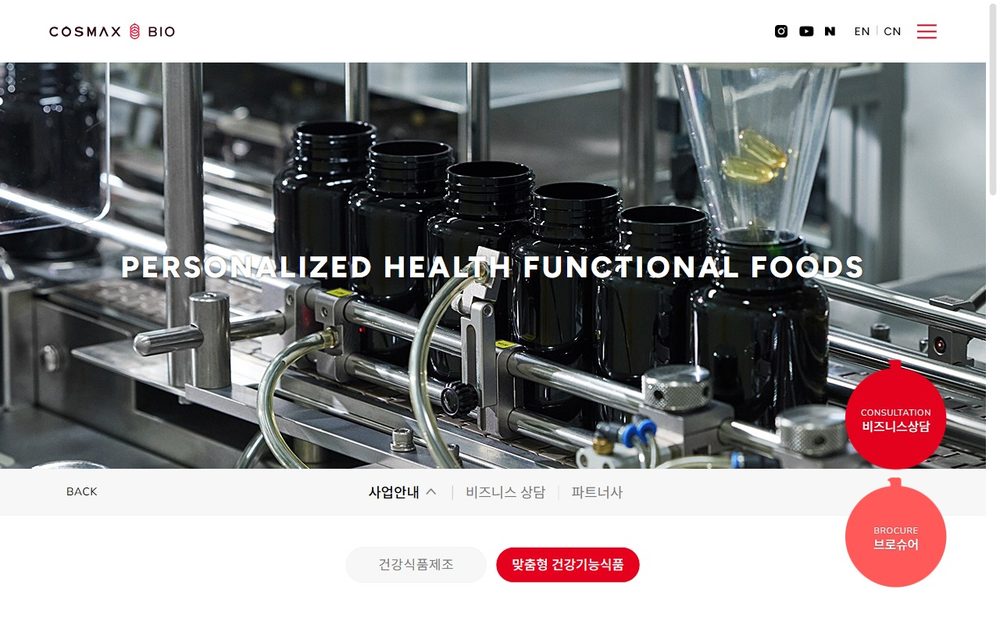
cosmaxbio.com, health functional food business page, captured August 2026. The homepage hero is a background video, so the business page is shown instead.
5. Suheung
Three stated business areas: empty hard capsules, food, and pharmaceuticals. Head office at Osong, Cheongju. Its site runs in Korean, English, Chinese, Japanese and Vietnamese.
Manufacturing note. A capsule maker that also does contract manufacturing is a different proposition from a pure contract manufacturer — the shell is made in-house rather than bought in. If your product is a capsule and shell composition matters to you (gelatin origin, vegetarian, colourant), this is the kind of supplier that can answer the question rather than forward it.
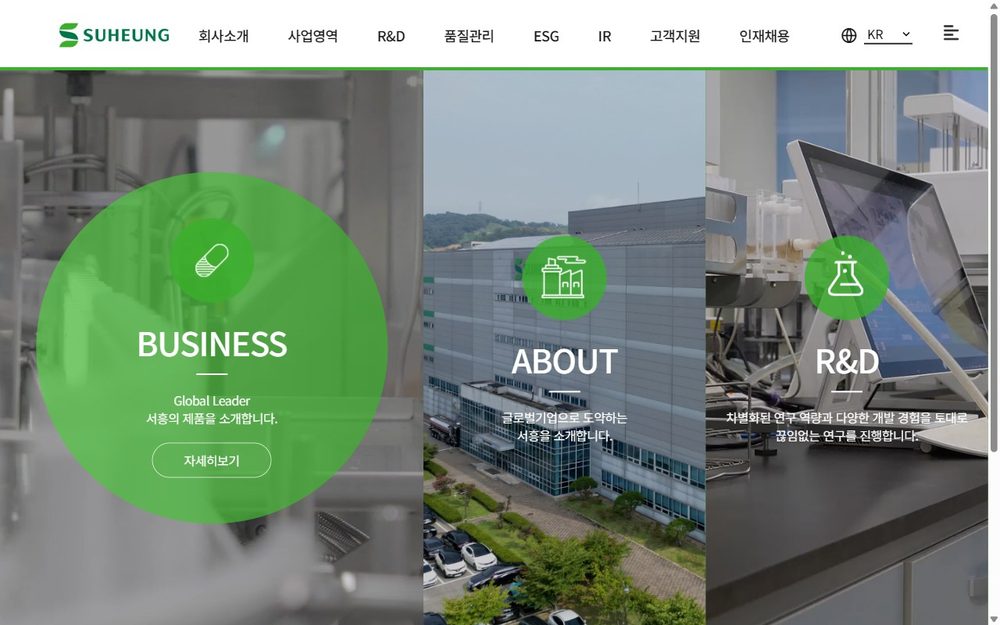
suheung.com, captured August 2026.
6. Naturetech
Site title states health functional food and cosmetics OEM/ODM. Head office and plant in Jincheon, Chungcheongbuk-do; Seoul office with separate food, cosmetics and overseas sales teams. MFDS individual recognition for a salmon nasal cartilage extract, September 2025.
Manufacturing note. A named overseas sales team on the contact page is a small signal that matters when you are the foreign enquiry: it means answering you is someone's job, rather than your email joining the domestic queue.

naturetech.co.kr, captured August 2026.
7. Wooree Bio
Health functional food manufacturing with a dedicated OEM/ODM section. Head office in Ansan, Gyeonggi-do; Seoul office on Teheran-ro, Gangnam. Site runs in Korean, English and Chinese. Lists its own analytical infrastructure — physicochemical testing, microbiological testing and stability testing equipment.
Manufacturing note. Naming stability testing equipment specifically is the useful detail. Stability data is what supports a declared shelf life, and shelf-life-remaining rules at import are a live constraint for anyone shipping to the Gulf. A factory with its own stability chambers can generate that data instead of outsourcing it.
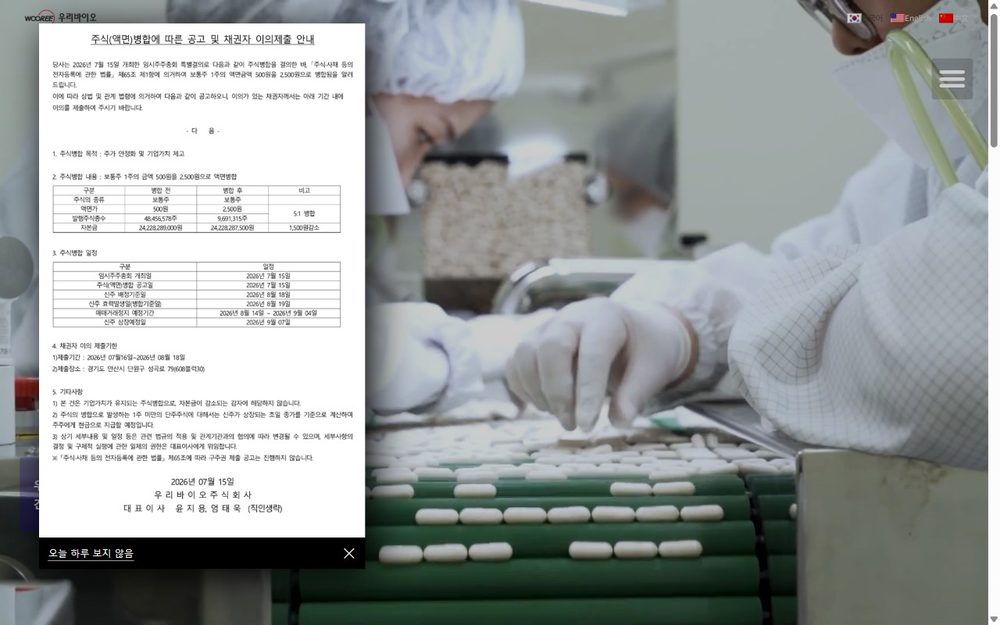
wooreebio.co.kr, captured August 2026.
8. Nutricare
Describes itself as an "OEM & ODM Manufacturer of Healthcare and Functional Food Products", stating 20 years of experience, and sets out its OEM and ODM workflows step by step — from item declaration and advertisement review through to shipment and sample retention.
Manufacturing note. Nutricare publishes the most detailed English-language process description in this list. For a Malaysian brand owner that is not a minor convenience: it is the difference between reading a specification yourself and approving a document you cannot check.
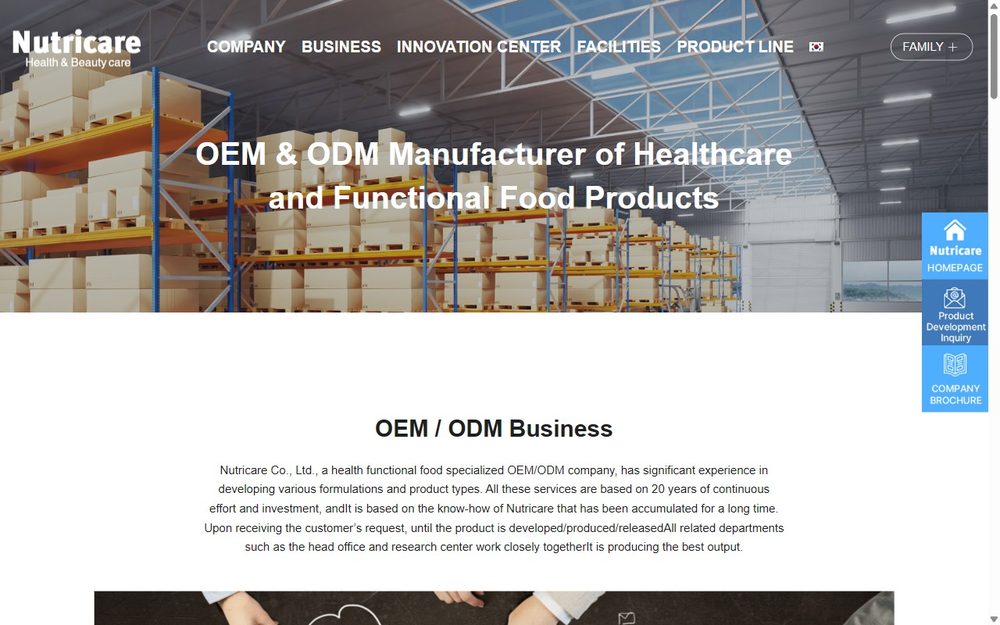
nutricarehc.com, captured August 2026.
9. NPK Inc.
Two plants in Damyang, Jeollanam-do — head office with the first factory, and a second factory nearby. Korean business registration 409-86-12459. Runs both a Korean site and a separate English one.
Its stated position is clean label: the first company to introduce natural vitamins in Korea, with organic raw material development, and no colour additives, sweeteners, synthetic flavouring or synthetic excipients. It also sells its own bio-materials, including patented enzyme and strain ingredients.
Its OEM enquiry board is public and visibly active — recent posts cover probiotic OEM, softgel-plus-tablet sets, effervescent tablet packaging and powder sticks.
Manufacturing note. A public enquiry board is an unusual amount of transparency: it shows what the factory is actually being asked for, rather than what its brochure claims. The clean-label position is also the one on this list that travels best into Malaysia, where synthetic additives are a live consumer issue.
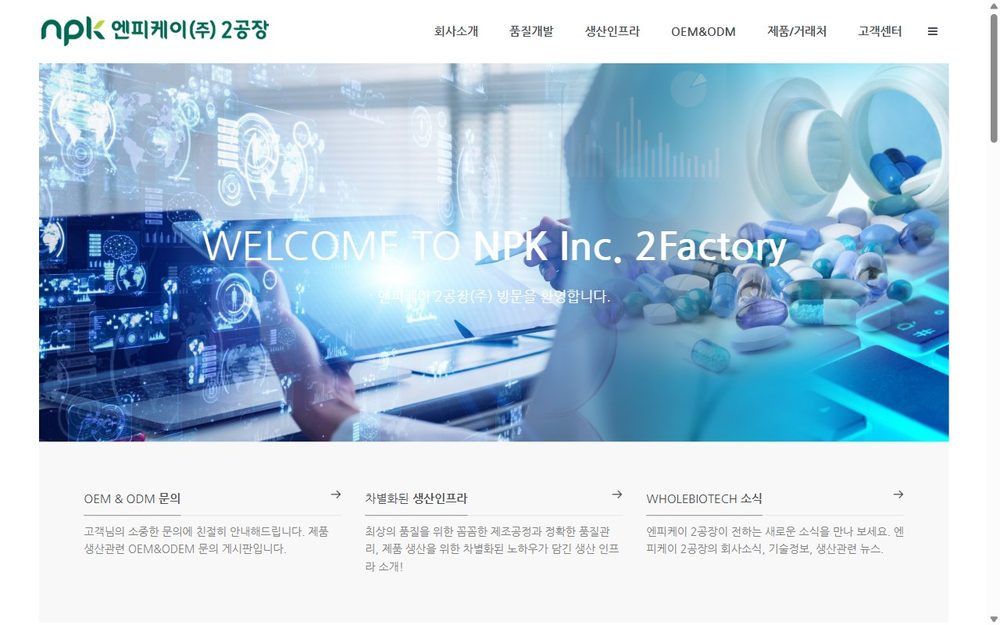
wholebiotech.com, captured August 2026. NPK also runs an English site.
10. Cheum Bio
A specialist rather than a giant, and the entry most likely to answer a first email. States over 400 client partnerships, HACCP-certified manufacturing, and formats covering tablets, powders and stick packs. Its own page title advertises small-batch production and a free quotation, and its stated category focus is inner beauty, immunity and gut health.
The site is presented in English.
Manufacturing note. "Small batch" and "free quote" on the page title is a positioning decision, and it tells you who this factory wants to hear from. For a brand testing a first product, a manufacturer that has built its business around short runs is a fundamentally different experience from one whose smallest comfortable order is a domestic retail launch.
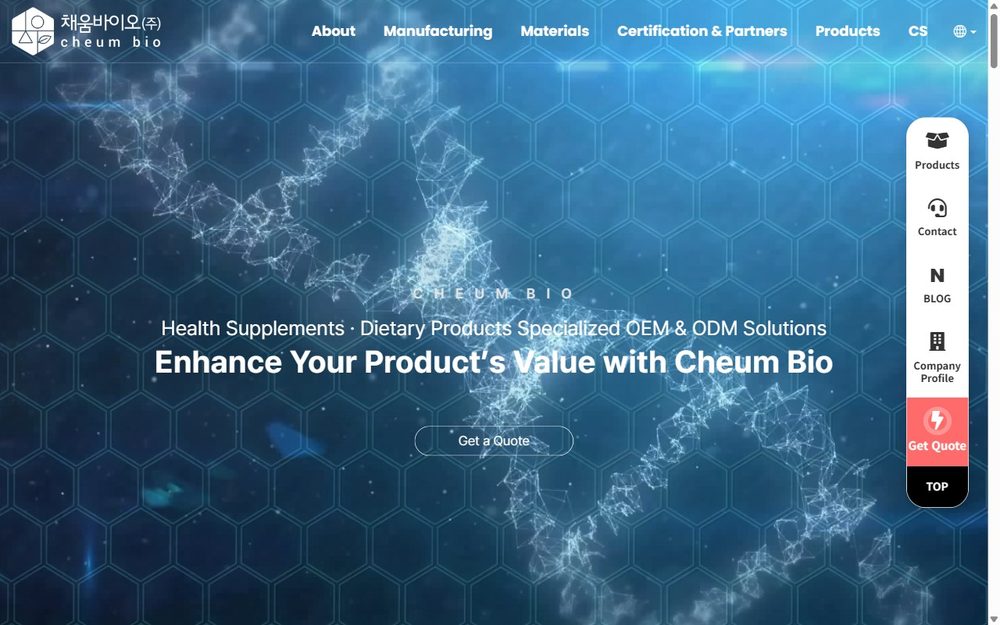
cheumbio.com, captured August 2026.
Also verified: Sangsang Bio (QOEM)
An eleventh company was verified to the same standard and belongs in the same tier as Cheum Bio — it is outside the numbered ten only because the list is ten.
Sangsang Bio runs the QOEM platform, positioned explicitly on small-batch health functional food production. Two plants: Dangjin, Chungcheongnam-do (states GMP, HACCP, FDA-registered, SQF) and Hwasun, Jeollanam-do (states HGMP, GMP, HACCP, FDA-registered). Seoul office in Gangnam.
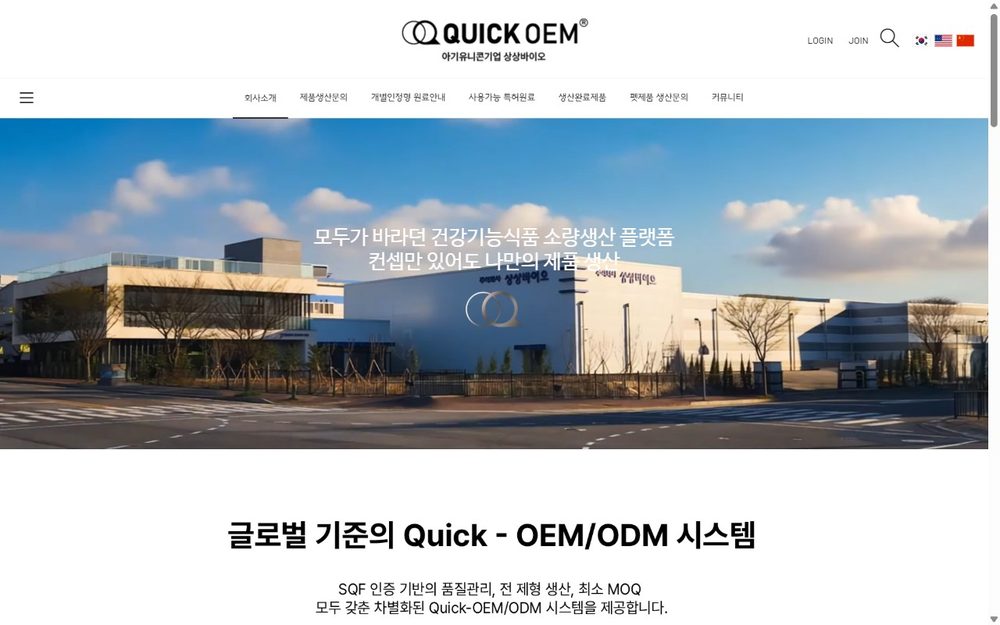
qoem.co.kr, captured August 2026.
What does this list actually tell you?
| Finding | What it means for your enquiry |
|---|---|
| Most sites are Korean-first | Nutricare, NPK, Wooree Bio, Suheung and Cheum Bio publish in English; several others do not. Contract for English specifications and certificates of analysis in writing, in advance |
| Jelly and liquid capacity is being expanded | Ask what your powder concept looks like as a jelly stick — that is where the supply chain is heading |
| Individual ingredient approvals are a selling point | Ask who owns the approval. It does not travel with you to another factory |
| The small-batch tier advertises itself | Cheum Bio and Sangsang Bio put small runs in the page title. That is where a first-time foreign brand should start |
| Not one of the eleven leads with Halal | Consistent with Korea not being a Halal-driven market. Verify before assuming, never assume before verifying |
That last row is the one to carry. If your product must carry a Halal logo for Malaysia, Indonesia or the Gulf, Korea is very likely the wrong manufacturing base — however good the samples are. That decision belongs at the start of the project, not after the packaging is designed.
Which candidates were dropped, and why?
Worth reading, because two of these are traps rather than judgements:
- NutriBiotech. The domain
nutribiotech.co.kris an ingredient-information media site, not the ODM. Naming the company and linking that domain would have sent readers to an entirely different business. - oemkorea.com. A matchmaking platform, not a factory. It reads like a manufacturer index and ranks well for manufacturer searches. Useful for finding factories; not itself one.
- Ilhwa. A real and long-established Korean company, but nothing on its site substantiates an OEM or ODM offer to third-party brands. Being a manufacturer of your own products is not the same as being a contract manufacturer.
- Large Korean supplement brands generally. Being "OEM friendly" is not being an OEM.
Two more — HPO/Biopharm and CKD Bio — are absent only because no working official site could be reached during this pass. That is a gap in the research, not a judgement on them.
How should you shortlist from here?
- Decide the Halal question first. It keeps or removes the whole country.
- Match the tier to your size. The Big 4 for volume; entries 9 to 11 for a first run.
- Ask for the certificates, not the certification claims. Every company here states certifications on its own website. A stated certification is where verification starts, not where it ends.
- Establish the working language in the first email, and who your day-to-day technical contact will be.
- Ask whether you are talking to the factory or an agent. Both are legitimate; you need to know which.
The full question list is in Top 10 Questions to Ask an OEM Supplement Manufacturer in Malaysia — the questions are the same wherever the factory is.
Where D&O fits
D&O Nutraceutical Manufacturing manufactures powder functional food — instant beverages, supplement powders, meal replacement, savoury instant food and seasoning — at its plant in Lahat, Perak. Certifications: Halal (JAKIM, MS 1500), GMP (SIRIM QAS, MS 1514:2022, cert. GMP 00203), HACCP (SIRIM QAS, MS 1480:2019, cert. HACCP 00425), ISO 22000 (cert. FSMS 00229) and MeSTI (cert. ME0523069-0/1).
We are not on this list and should not be — it is a list of Korean factories. We publish it because the question brand owners ask us most often is whether to source from Korea, and a real answer to that is more useful than a sales pitch. Where we are usually the better answer is a product that has to carry a Halal certificate, or one that sells across ASEAN and the Gulf from a single production run.
Frequently asked questions
Who are the biggest OEM supplement manufacturers in Korea? Korean trade press names Novarex, Kolmar BNH, Cosmax BTI and Suheung as the health functional food ODM "Big 4". All four are covered above, alongside Cosmax NBT, Cosmax Bio, Naturetech, Wooree Bio, Nutricare, NPK Inc., Cheum Bio and Sangsang Bio.
Will a Korean OEM take a small order from a Malaysian brand? The large ODMs are built around domestic volume. The companies that advertise small-batch production — Cheum Bio and Sangsang Bio's QOEM platform are the clearest examples here — are the realistic starting point. Minimum order quantities are set per factory and per format, so ask directly.
Can a Korean OEM make a Halal-certified supplement? Not one of the eleven companies verified here leads with Halal certification, which is consistent with Korea not being a Halal-driven market. Where a plant does hold a certificate, check whether the certifying body appears on JAKIM's list of recognised foreign Halal certification bodies.
Do these manufacturers work in English? Several publish in English — Nutricare, NPK Inc., Wooree Bio, Suheung and Cheum Bio among them — and several do not. Agree in advance which language your specifications, certificates of analysis and stability data will be supplied in.
Is this list ranked by quality? No. None of these plants has been audited by us. The order runs from the largest ODMs to the small-batch specialists, and the list is a verified starting point for your own due diligence.
How current is this? Every entry was captured in August 2026. Company websites are redesigned and certifications change — treat anything here older than a few months as a lead to re-check rather than as a fact.
What we did and did not do
Every entry above is what the company states about itself on its own website, read in August 2026. We have not visited or audited any of these plants, and the order is by profile and scale rather than by merit. It is where your own due diligence starts, not where it finishes.